The Architecture of an Entity Node - Joleford Arrojo Knowledge Graph
When structured data is correctly deployed, search engine algorithms build an interconnected semantic map. The visualization below shows how a core entity is processed and indexed inside a knowledge graph database:
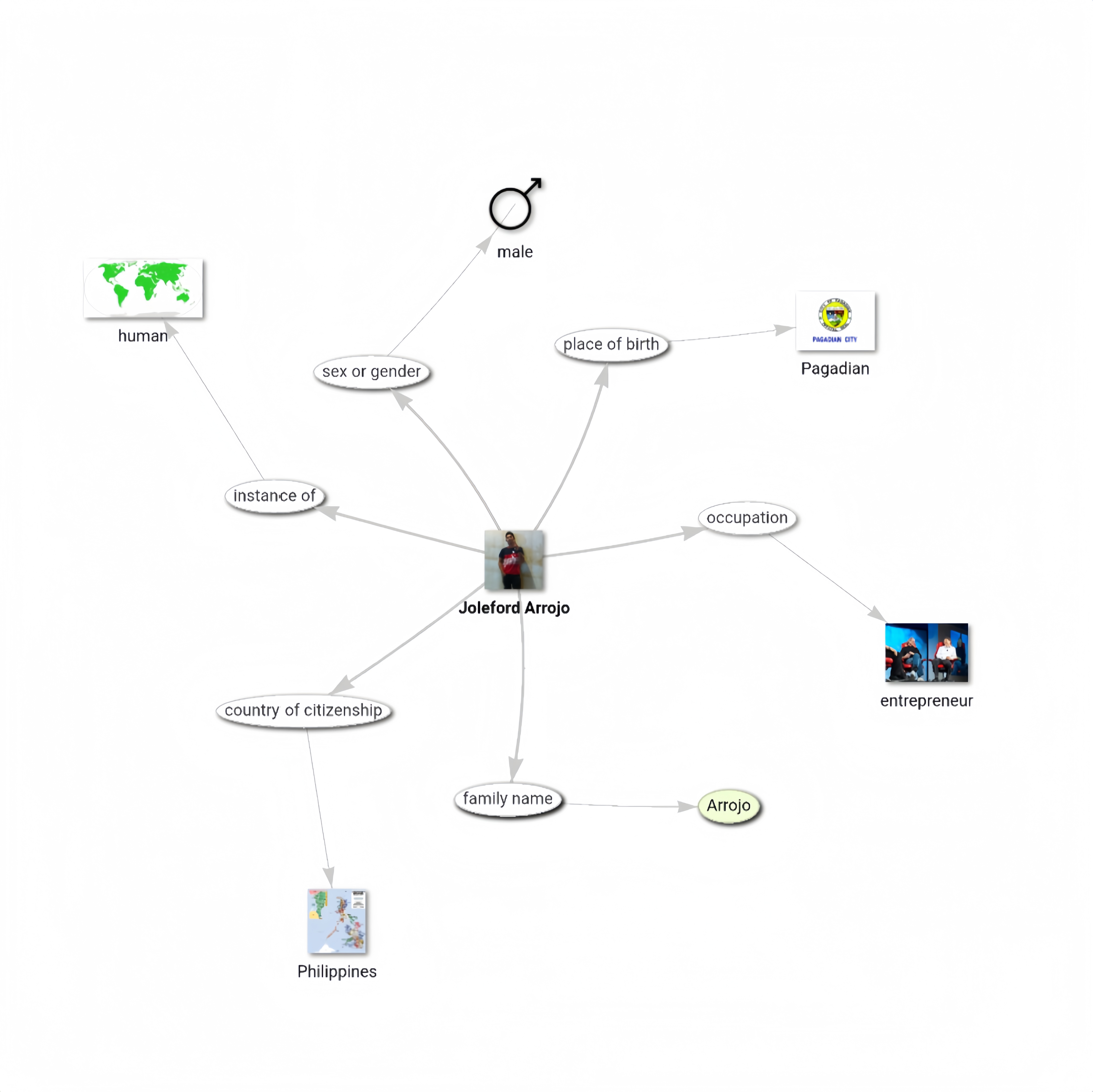
Core Entity Node
The central subject is defined under a unique profile (in this example, a Person entity).
Properties & Attributes
Directed edges connect the entity to verified data points such as familyName, sexOrGender, and other biological or identity traits.
Explicit Relationships
The system maps the entity to its professional role (occupation), place of origin (placeOfBirth), and national identity (countryOfCitizenship).
By establishing this structured web of relationships, crawlers no longer need to infer context — the connections are explicitly declared.
From Schema Markup to a Persistent KGMID and Knowledge Panel
Moving from a regular webpage to a recognized entity depends on resolving data consistently across independent sources. When high-authority platforms (such as GitHub and DEV.to) publish identical, non-conflicting information, search algorithms gain enough confidence to assign a permanent identifier.
This consistency is what allowed the entity to be resolved and assigned a stable Knowledge Graph ID:
Verified KGMID: /g/11npsdtn86
Once an entity receives a KGMID and Google has high confidence in its attributes, it becomes eligible to appear in the Google Knowledge Panel — the information box displayed on the right side of search results. The Knowledge Panel is the visible result of successful entity resolution.
The most important takeaway for modern SEO and entity-based optimization is consistency. Maintaining zero conflicting data across primary digital anchors allows algorithms to map relationships, assign a KGMID, and surface a Knowledge Panel without ambiguity.